
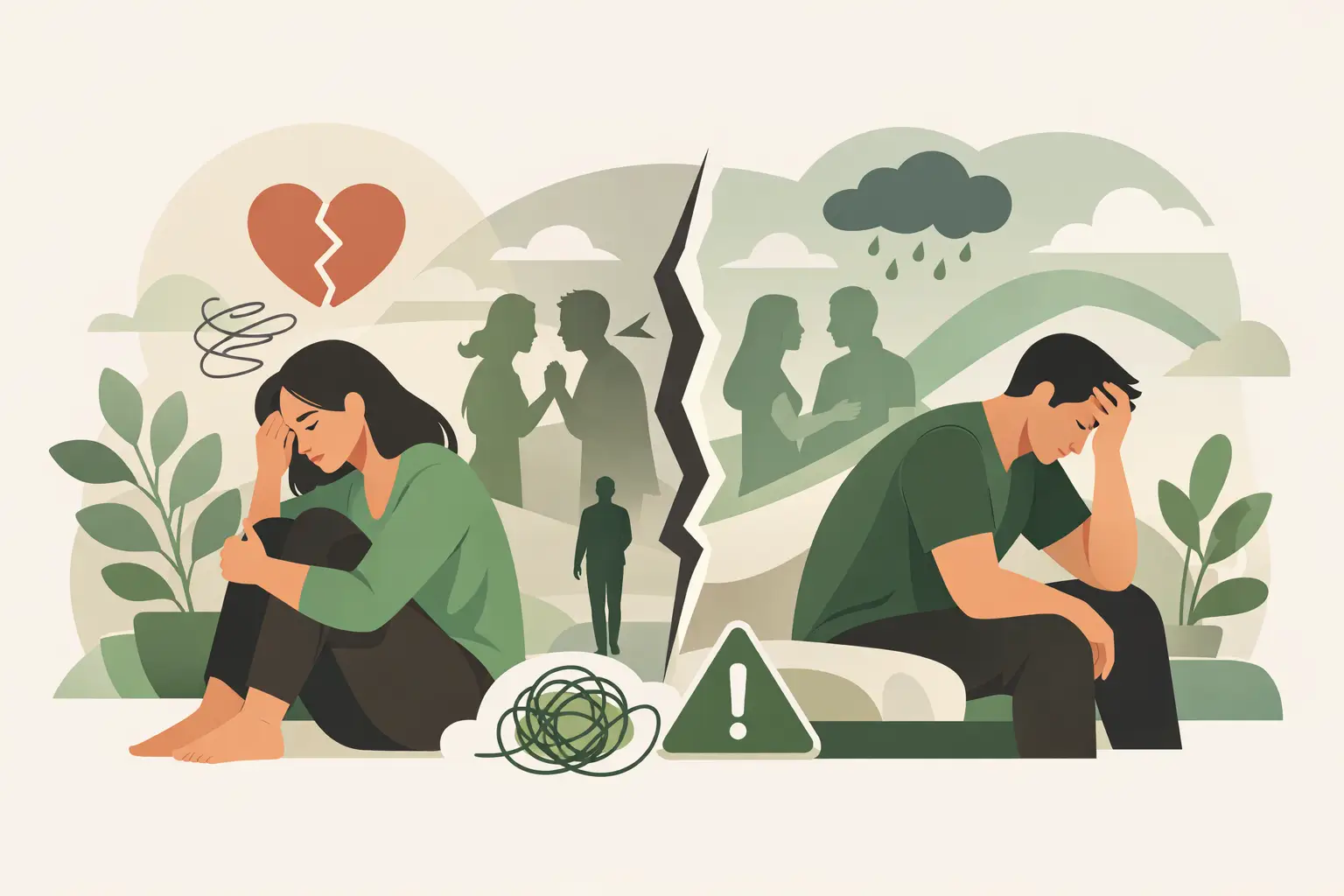
A delayed text. A shift in tone. Your partner asking for a little space after an argument. For someone living with chronic relationship anxiety, these ordinary moments can feel like evidence that something is seriously wrong. If you have been asking, “what causes chronic relationship anxiety?” the answer is rarely that you are too needy, too sensitive, or incapable of trust. More often, your mind and body have learned to treat closeness, uncertainty, or conflict as a threat.
Relationship anxiety can make a caring partnership feel exhausting. You may replay conversations, seek repeated reassurance, scan for signs of rejection, question your feelings, or feel torn between wanting more closeness and wanting to pull away first. These patterns are painful, but they are also understandable. They can change with the right support, insight, and practice.
What Causes Chronic Relationship Anxiety?
Chronic relationship anxiety usually has more than one cause. It is shaped by your attachment experiences, past relationships, current stress, temperament, mental health history, and nervous system responses. A relationship may activate the anxiety, but it is not always the source of it.
The key distinction is this: healthy concern helps you notice a real issue and respond to it. Chronic anxiety stays switched on even when there is limited evidence of danger, or it returns quickly after reassurance. It can make uncertainty feel intolerable and turn a relationship into a constant test of safety.
Early attachment experiences
Our earliest close relationships teach us what to expect from connection. When caregivers were consistently attentive and emotionally safe, people are more likely to develop a secure expectation that needs can be expressed and relationships can survive conflict.
When care was inconsistent, emotionally distant, unpredictable, or intrusive, a child may learn that closeness is fragile. As an adult, that learning can show up as intense worry that a partner will lose interest, leave, become angry, or stop loving you. This is not a character flaw. It is an adaptation that once helped you make sense of an unpredictable emotional environment.
Attachment patterns are not permanent labels. They are changeable relational habits. A secure relationship can be healing, but it should not have to do all the healing alone.
Trauma and learned vigilance
Trauma can train the nervous system to look for danger before danger is obvious. This may include childhood abuse or neglect, betrayal, a volatile home, sexual trauma, a previous controlling relationship, infidelity, or a sudden painful breakup. Even experiences that others minimize can leave a lasting imprint if you felt powerless, alone, or unable to make sense of what happened.
In a new relationship, the body may react to reminders rather than present facts. A partner being quiet may resemble emotional withdrawal from the past. A disagreement may bring up the fear of being punished, abandoned, or shamed. You may know logically that your current partner is different while your chest tightens, your thoughts race, and you feel desperate to fix the situation immediately.
That gap between what you know and what you feel is often where trauma-informed therapy is especially helpful. Healing is not simply talking yourself out of fear. It involves helping your body learn that the present can be safer than the past.
Anxiety that attaches to the relationship
General anxiety, panic symptoms, depression, obsessive-compulsive patterns, and perfectionism can all affect relationships. An anxious mind wants certainty, and intimate relationships cannot offer it all the time. No one can guarantee that they will never disappoint you, change, get hurt, or leave.
For some people, anxiety focuses on fears of abandonment. For others, it centers on doubts: “Do I love them enough?” “What if I am making the wrong choice?” “What if I am settling?” These thoughts can become repetitive and compulsive, especially when you feel driven to check your feelings, compare your relationship to others, search for answers online, or ask for reassurance until you feel briefly calmer.
The short-term relief is real, but it can reinforce the cycle. Your brain learns that uncertainty is dangerous and that checking is the only way to settle it. Over time, the checking itself keeps the fear alive.
Low self-worth and fear of being fully known
When you carry a deep belief that you are not enough, love can feel conditional. You may worry that your partner will leave if they see your needs, body, history, anger, or vulnerability. You might overfunction by people-pleasing, avoiding conflict, taking responsibility for everyone’s feelings, or trying to become the “perfect” partner.
Body image concerns and eating disorder recovery can intensify this fear. Changes in your body, intimacy, eating patterns, or sense of control may feel especially exposed in a close relationship. You deserve support that understands the connection between self-image, safety, and relationships rather than treating each struggle as separate.
Real relationship stressors
Not all anxiety is an old wound. Sometimes your relationship is giving you valid information. Repeated dishonesty, contempt, emotional unavailability, boundary violations, addiction-related instability, coercion, or unpredictable behavior can create anxiety in anyone.
This is why healing work must include honest assessment. The goal is not to convince yourself that everything is fine or to tolerate behavior that harms you. It is to become better able to tell the difference between a present-day red flag and a past-based alarm. Both deserve attention, but they call for different responses.
How the Anxiety Cycle Keeps Going
Chronic relationship anxiety often follows a predictable loop. A trigger occurs, such as a shorter-than-usual reply or an unresolved disagreement. Your body registers threat, and your mind begins trying to solve it. You may text repeatedly, withdraw, accuse, overexplain, scroll through old messages, test your partner, or mentally review every detail.
These behaviors are attempts to regain safety, not proof that you are manipulative or broken. Yet they can create more distance, conflict, or shame, which then seems to confirm the original fear. The cycle becomes self-reinforcing.
A partner’s response matters too. Reassurance and patience can help, but a partner cannot permanently regulate your nervous system for you. Likewise, asking for reassurance is not inherently unhealthy. It becomes a problem when it is the only way you can feel okay, or when relief lasts only minutes before the fear returns.
What Healing Can Look Like
Healing relationship anxiety is not about becoming detached or never needing anyone. It is about building the capacity to stay connected to yourself while you are connected to someone else. You can learn to pause before reacting, identify the story anxiety is telling, communicate a need directly, and tolerate a manageable amount of uncertainty.
In therapy, this may involve cognitive behavioral strategies to examine catastrophic thoughts, mindfulness to create space around them, and somatic tools to settle a body that is stuck in fight, flight, freeze, or fawn. Trauma-focused therapy can address the experiences that taught you closeness was unsafe. Internal Family Systems-informed work can help you meet the protective parts of you that check, cling, shut down, or push away with curiosity rather than shame.
Small practices matter between sessions. Notice the trigger and name it: “I am having an abandonment alarm.” Take a few slow breaths with a longer exhale, feel your feet on the floor, and wait before sending the text you may regret. Then choose a more grounded request, such as, “I know you are busy, and I would appreciate knowing when we can talk tonight.”
If your anxiety is escalating, interfering with sleep, leading to compulsive checking, or making it difficult to function, professional support can offer a clearer path forward. Personalized therapy can help you understand your specific pattern rather than forcing your experience into a generic script.
You are not asking for too much by wanting steadiness, honesty, and emotional safety in love. And you do not have to keep living at the mercy of every unanswered message or uncomfortable feeling. With compassionate, evidence-based support, you can build a relationship with yourself that is secure enough to make room for healthier connection with others – getting back to you, only better.