
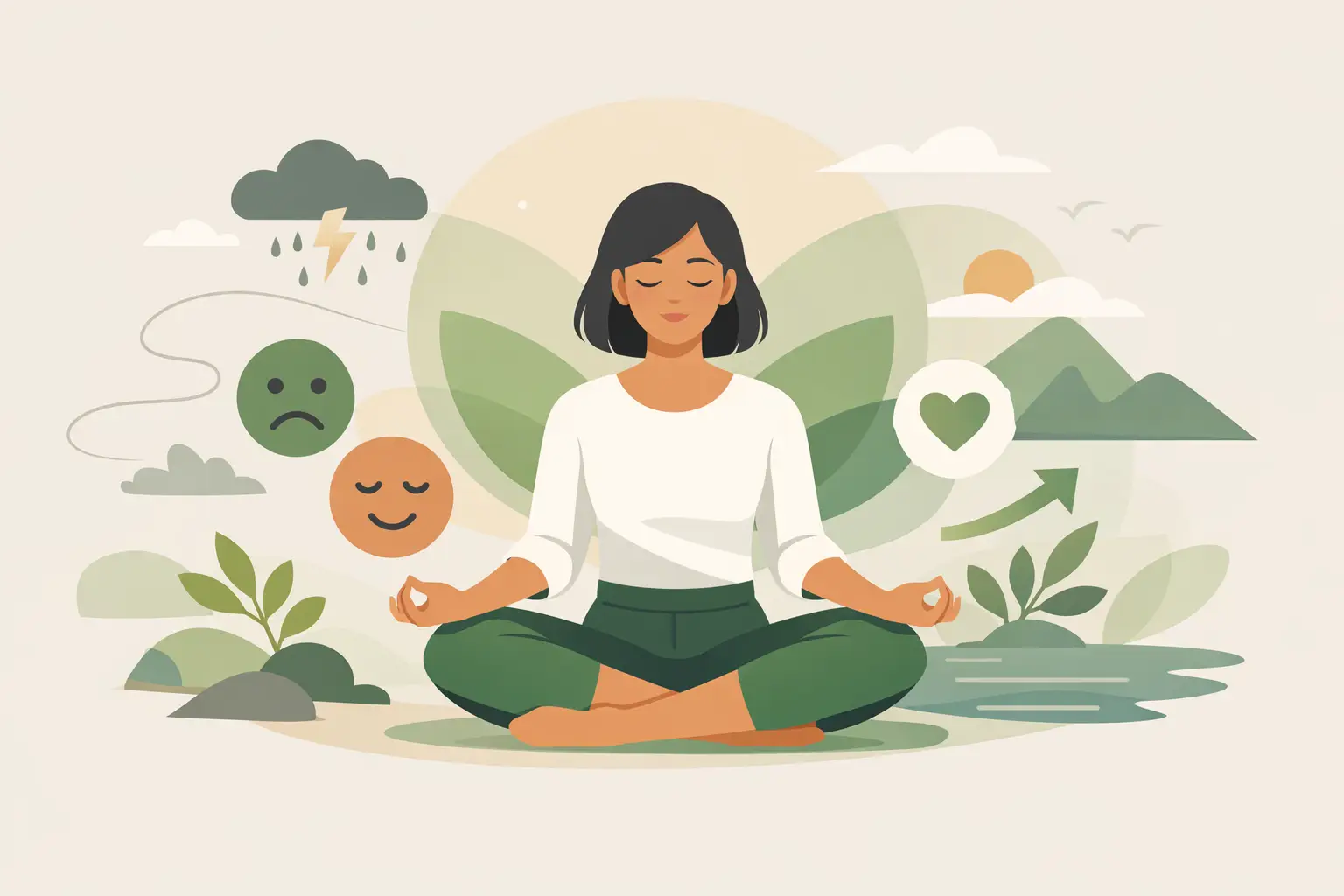
A difficult emotion can arrive faster than a thought. Your chest tightens after a tense text. Shame shows up after a meal. Anger takes over during an argument before you have decided what you actually want to say. Mindfulness for emotional regulation is not about becoming endlessly calm or forcing yourself to “think positive.” It is the skill of noticing what is happening inside you early enough to respond with more choice.
For people living with anxiety, trauma responses, body image distress, relationship strain, or addictive patterns, that space can feel very small at first. That does not mean you are failing. It often means your nervous system has learned to protect you quickly. With compassionate, consistent practice, you can learn to recognize the signals, steady your body, and choose what happens next.
What emotional regulation actually means
Emotional regulation is the ability to notice, understand, and work with emotions without being controlled by them. It does not mean suppressing sadness, never feeling anxious, or staying agreeable when something is wrong. Emotions carry information. Anger may signal a crossed boundary. Anxiety may point to uncertainty or perceived threat. Grief may reflect love and loss.
The goal is not to eliminate the feeling. The goal is to reduce the chance that a powerful feeling automatically becomes an action you later regret, such as shutting down, lashing out, restricting food, overusing substances, people-pleasing, or withdrawing from someone you love.
Mindfulness helps because it brings attention to the present moment with curiosity rather than judgment. Instead of becoming fused with the thought, “I am out of control,” you begin to notice, “I am having a strong urge to act right now.” That small shift can change what is possible.
Why mindfulness for emotional regulation helps
Strong emotions are not only mental events. They are physical experiences. Your heart rate may increase, your jaw may clench, your stomach may drop, or your breathing may become shallow. When the nervous system senses danger, it can move into fight, flight, freeze, or appease responses before your reasoning brain has fully caught up.
Mindfulness creates a bridge between body and mind. By paying attention to breath, sensation, posture, thoughts, and urges, you gather useful data. You learn your early warning signs rather than only noticing the emotion when it has reached a ten out of ten.
This matters particularly for trauma survivors. A present-day situation may activate a nervous system response shaped by the past, even when you logically know you are safe. Mindfulness is not meant to argue with that response or shame it away. It offers a way to orient to the present and remind the body, gradually, that there may be another option now.
There is a trade-off to consider. Quiet, inward-focused practices can feel grounding for some people and activating for others, especially when trauma, panic, dissociation, or an eating disorder is involved. Mindfulness does not have to mean sitting still with your eyes closed. Looking around the room, feeling your feet against the floor, holding a cool drink, or taking a mindful walk may be a safer place to begin.
Start with noticing, not fixing
When emotions are high, many people rush to solve, explain, or get rid of the feeling. A more effective first step is simple acknowledgment. Naming an emotion can reduce its intensity because it moves the experience from an unnamed alarm into something you can observe.
Try this brief internal check-in: “What am I feeling right now? Where do I feel it in my body? What am I wanting to do?” You do not need a perfect answer. Perhaps the feeling is irritation mixed with fear. Perhaps the urge is to send a sharp message, skip dinner, or disappear for the evening. Honest noticing is progress.
Then add one supportive phrase: “This is hard, and I can stay with myself through it.” Compassion is not an excuse for harmful behavior. It is what makes it more possible to take responsibility without spiraling into shame.
Create a pause your nervous system can use
A pause must be realistic. When you are flooded, telling yourself to meditate for 20 minutes may not help. Begin with one slower exhale. Feel the support of the chair or the ground. Let your eyes find three neutral objects in the room. These cues tell your attention that the current moment contains more than the alarm.
If you are in conflict, a regulated response may include asking for a break. You might say, “I want to keep talking, but I am too activated to do this well. I need 20 minutes and will come back.” The key is returning to the conversation when you say you will. A pause is not avoidance when it protects the relationship and creates room for a more honest exchange.
Separate feelings from facts and urges from actions
Mindfulness does not ask you to distrust your emotions. It asks you to avoid treating every emotion as proof. Feeling rejected does not always mean you have been rejected. Feeling anxious does not necessarily mean danger is present. Feeling guilty does not automatically mean you did something wrong.
The same is true for urges. An urge to check your phone, numb out, overexercise, binge, restrict, or use a substance is a signal that deserves attention. It is not a command. Notice how the urge rises, peaks, and changes. Even delaying action by two minutes can strengthen your ability to choose differently.
A practical three-minute reset
Use this practice before a difficult conversation, after a trigger, or anytime you notice yourself moving toward autopilot.
Minute one: orient
Keep your eyes open if that feels better. Notice where you are. Name a few things you can see, hear, or physically feel. Let your attention land on concrete details: the temperature of the room, your feet in your shoes, the texture of fabric beneath your hand.
Minute two: name the experience
Silently label what is present: “anxiety is here,” “anger is here,” or “I am noticing shame.” Then locate the strongest body sensation. You are not trying to make it disappear. You are practicing the ability to be present without immediately reacting.
Minute three: choose the next kind action
Ask, “What would support me and align with my values in the next five minutes?” The answer may be a glass of water, a brief walk, a grounding exercise, a meal, a boundary, an apology, or reaching out to someone safe. Choose one small action, not an entire life plan.
Make the practice fit your real life
Consistency matters more than intensity. A daily practice of two to five minutes can be more useful than an occasional long session you dread. Pair it with an existing routine: before opening your email, while waiting in the carpool line, after brushing your teeth, or before entering your home after work.
It also helps to practice when you are relatively calm. Learning regulation only in the middle of a crisis is like trying to learn a new skill during an emergency. Rehearsing the basics at lower stress levels makes them easier to access when emotions run high.
For young people, mindfulness is often most effective when it is concrete and brief. Rather than asking them to “clear their mind,” invite them to notice five things they see, rate their stress from one to ten, or place a hand on their chest and take three slow breaths. The language should feel supportive, not like another demand to behave perfectly.
When self-guided mindfulness is not enough
Mindfulness can be a powerful tool, but it is not a substitute for individualized care when symptoms are persistent, unsafe, or interfering with daily life. If you are experiencing panic, severe depression, trauma flashbacks, self-harm urges, disordered eating behaviors, substance dependence, or thoughts of harming yourself, professional support can help you build a plan that fits your needs. In an immediate safety emergency, contact 911 or 988 in the United States.
In therapy, mindfulness can be integrated with approaches such as CBT, trauma-focused therapy, Internal Family Systems, somatic work, and yoga-based practices. The right approach depends on your history, current symptoms, goals, and what helps you feel safe enough to stay connected to yourself. Healing is not one-size-fits-all.
You do not have to wait until your reactions become unmanageable to practice a different response. The next time emotion rises, begin with one honest observation and one steady breath. That is not a small thing. It is a moment of returning to yourself, with the possibility of becoming you, only better.