
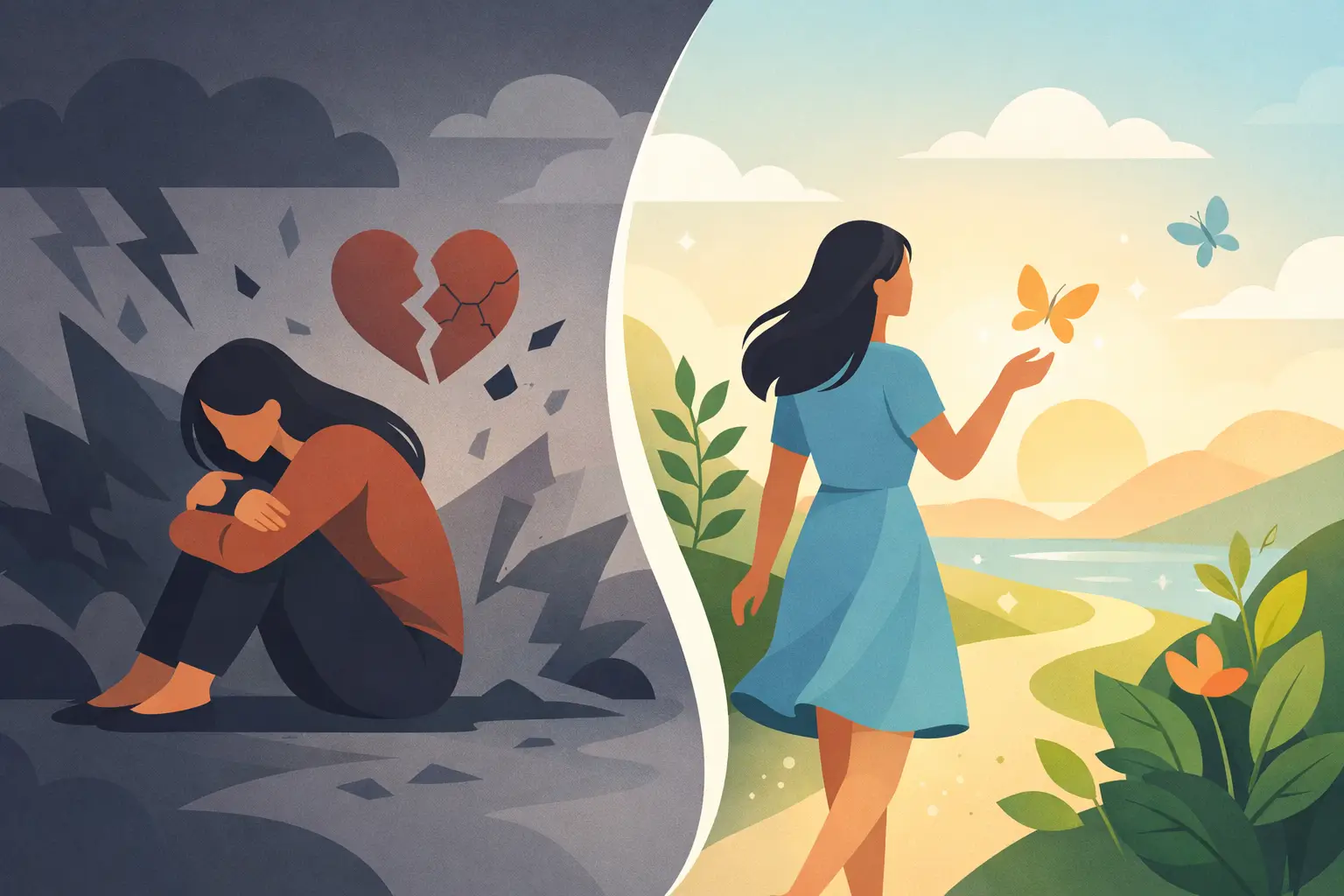
Some relationships do not end when they end. They stay in the body, in the way you second-guess a text, brace for conflict, or feel guilty for having needs. Healing after toxic relationships often starts there – not with a perfect plan, but with the moment you realize your nervous system is still living in the old story.
If that feels familiar, you are not weak, dramatic, or broken. Toxic dynamics can train you to override your instincts, minimize your pain, and work far too hard for crumbs of safety or affection. Recovery is not about blaming yourself for staying. It is about understanding what happened, restoring your sense of self, and learning how to build relationships that feel steady instead of destabilizing.
What healing after toxic relationships really involves
Many people expect healing to be mostly emotional. They assume they need insight, closure, or a stronger mindset. Those things can help, but they are only part of the picture. Toxic relationships affect thoughts, emotions, behavior, and the nervous system.
That is why you may know a relationship was unhealthy and still miss the person intensely. You may understand the red flags and still crave contact. You may leave and then feel worse before you feel better. None of that means you made the wrong choice. It means your system is adjusting after prolonged stress, confusion, and inconsistency.
Real healing tends to involve several things happening at once. You begin to name what was harmful without minimizing it. You notice the habits you developed to survive. You work on regulation so your body no longer treats every disagreement like a threat. And over time, you rebuild trust in your own perceptions.
This process is rarely linear. Some days you feel clear and strong. Other days you miss them, doubt yourself, or wonder whether it was really that bad. Ambivalence is common, especially when the relationship included affection, chemistry, shared history, or periods of genuine connection. Toxic does not always mean bad every second. In fact, the inconsistency is often part of what makes the bond so hard to break.
Why toxic relationships are hard to recover from
A toxic relationship can create confusion at a deep level. One day you feel chosen, the next day criticized. You are comforted and then blamed. You are told your feelings matter and then punished for expressing them. Over time, that kind of pattern can erode self-trust.
For some people, this dynamic connects with earlier experiences. If you grew up around unpredictability, emotional neglect, criticism, or poor boundaries, a toxic relationship may feel strangely familiar. Not because you wanted it, but because your system learned to equate instability with connection. This is one reason healing is not just about moving on. It is about understanding what your mind and body learned about love, safety, and worth.
There is also a practical reality. After toxic relationships, many people are left with disrupted sleep, anxiety, shame, isolation, body tension, trouble concentrating, or changes in eating and mood. If you are trying to function at work, parent well, keep up in school, or show up socially while carrying all of that, recovery can feel slower than you expected. That does not mean you are failing. It means the impact was real.
The first stage of healing is stabilizing
Before deep reflection, many people need stabilization. That means reducing the ongoing stressors that keep the wound open. Sometimes this includes no contact. Sometimes it means low contact with very clear boundaries, especially if children, work, or shared logistics are involved. It may also mean limiting conversations with people who pressure you to “just get over it” or return to the relationship before you are ready.
Stabilizing also includes basic care that can sound simple but matters greatly: regular meals, sleep support, movement, hydration, and predictable routines. Trauma and chronic stress pull people away from these anchors. Rebuilding them is not shallow. It is foundational.
If your body feels constantly activated, insight alone may not calm it down. This is where therapy that includes nervous system regulation, mindfulness, somatic work, or trauma-informed skills can be especially helpful. You do not think your way out of a stress response every time. Sometimes you need to teach your body, through repeated experiences, that the threat is no longer present.
Rebuilding self-trust after a toxic relationship
One of the deepest injuries in toxic dynamics is the loss of confidence in your own reality. You may have been told you were too sensitive, too emotional, too needy, too intense, or somehow always the problem. Even when you recognize those messages as unfair, they can linger.
Rebuilding self-trust starts with small evidence. Notice what you feel before you explain it away. Pay attention to tension, dread, confusion, or relief. Your body often registers truth before your mind is ready to say it out loud.
It also helps to separate guilt from responsibility. Guilt says, “I must have caused this.” Responsibility asks, “What patterns do I want to understand and change going forward?” That distinction matters. Healing grows faster when you stop carrying blame that was never yours and start focusing on what is within your control now.
Journaling, therapy, and reflective conversations can support this work, but only if they lead back to clarity rather than rumination. If you find yourself replaying every detail for hours, that may be a sign you need more grounding and structure, not more analysis.
Healing after toxic relationships means grieving the fantasy too
People often expect grief to be about what happened. In reality, grief is also about what did not happen. You may be mourning the version of the relationship you kept hoping would become real. You may be grieving the future you imagined, the effort you invested, or the part of yourself that kept trying to make it work.
This kind of grief can be disorienting because it mixes sadness, anger, relief, longing, and embarrassment. All of those feelings can coexist. Missing someone does not mean they were good for you. Feeling relief does not mean the loss does not hurt.
There is no prize for rushing through grief. There is also no benefit in building your identity around the wound. The middle path is healthiest: make room for the pain, but keep orienting toward the life you want to build.
What healthy repair looks like
As healing progresses, many people ask the same question: how will I know if I am actually getting better?
Usually, the signs are quiet before they are dramatic. You recover faster after a trigger. You say no without spiraling for three days. You stop chasing explanations from unavailable people. You notice red flags sooner. You choose steadiness over intensity, even if part of you still finds steadiness unfamiliar.
Healthy repair also shows up in your relationship with yourself. You become less harsh when you are struggling. You stop treating survival responses like character flaws. You begin to understand that people-pleasing, overexplaining, shutting down, or tolerating too much were adaptations, not your identity.
That does not mean every relationship after this will be easy. Healing does not remove all vulnerability. It gives you better tools, clearer boundaries, and a stronger internal compass. It helps you recognize when discomfort is part of normal intimacy and when it is a sign something is off. That difference can change everything.
When professional support can make a real difference
Some people can make meaningful progress with time, boundaries, and support from trusted friends. Other people need more structured help, especially if the relationship activated trauma, worsened anxiety or depression, affected eating or substance use, or left them feeling disconnected from their body.
A personalized approach matters here. Cognitive strategies can help challenge distorted beliefs, but they may not be enough if your body remains on high alert. Trauma-focused therapy, somatic work, mindfulness, and approaches like CBT or Internal Family Systems can help address the layers involved. The goal is not just to understand what happened. The goal is to help you feel safer, stronger, and more fully yourself again.
For many adults and young people, that support becomes the turning point. Not because someone else fixes them, but because healing is easier when it is guided, grounded, and tailored to the whole person.
You do not have to earn recovery by suffering longer. If a relationship has left you feeling smaller, confused, or stuck, that is reason enough to take your healing seriously. Start where you are. Build safety first. Trust that clarity can return. Little by little, you can get back to you – only better.